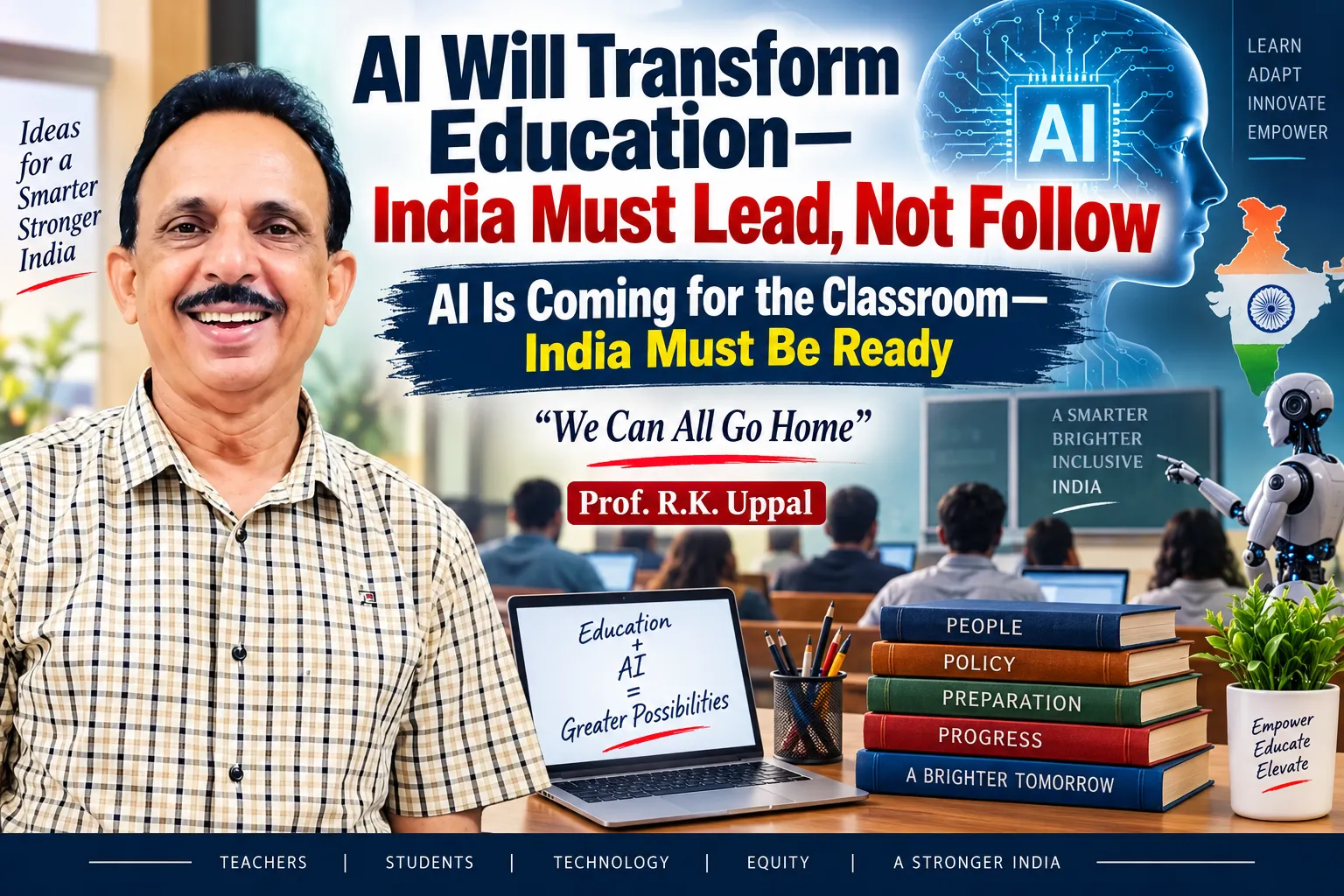
AI Will Transform Education—India Must Lead, Not Follow
AI Is Coming for the Classroom—India Must Be Ready
“We Can All Go Home”
Prof. R.K. Uppal
Artificial Intelligence is no longer a distant technological possibility. It has already entered classrooms, universities, research laboratories and academic offices. From generating study material and answering questions to assisting research, analyzing data and creating presentations, AI is rapidly changing the way education is delivered and consumed. For India, this transformation presents both an extraordinary opportunity and a serious warning. The question is no longer whether AI will influence higher education. The real question is whether Indian universities, teachers and students are prepared to use it responsibly and effectively.
India has one of the world's largest higher education systems, with millions of students and a vast network of universities, colleges and teachers. Such a massive system cannot remain untouched by the AI revolution. The traditional model of education—teacher lectures, students take notes, examinations test memory and degrees certify completion—are under increasing pressure. AI can instantly provide explanations, generate examples, translate material, assist with coding, analyze information and support personalized learning. This means that the classroom of tomorrow cannot simply be a slightly digitized version of today's classroom.
The greatest opportunity offered by AI is personalized education. Every student learns differently. Some require additional explanations; others need more challenging material, while some benefit from visual or practical examples. AI-powered systems can potentially provide learning support according to individual needs. A student struggling with economics, mathematics, accounting or programming can receive additional explanations and practice exercises without waiting for the next classroom session. This can make education more inclusive and learner-centered.
AI can also become a powerful assistant for teachers. Faculty members spend considerable time preparing lectures, developing questions, evaluating assignments, preparing reports and performing administrative tasks. Properly used, AI can reduce some of this routine workload and allow teachers to spend more time on mentoring, discussion, research and individual student development. But AI should assist teachers—not eliminate the teacher's intellectual and human role.
This distinction is extremely important. Education is not merely information transfer. A machine can provide an answer, but education must teach students how to question that answer. A Chabot can generate an essay, but it cannot automatically develop intellectual maturity, ethical responsibility, empathy or wisdom. The teacher remains essential because education involves human interaction, motivation, judgment and values.
Many teachers have limited exposure to generative AI, machine learning, prompt design, AI-assisted research and the ethical challenges associated with automated systems. Universities cannot simply introduce AI platforms and expect faculty to become competent users overnight. Continuous professional development must become an institutional priority. Teachers should receive practical training on how AI can be integrated into teaching, assessment, research and academic administration.
The assessment system requires particularly urgent reform. If an AI system can produce a reasonably sophisticated essay within seconds, traditional assignments may no longer accurately measure student learning. Universities must therefore move towards assessments that demand analysis, creativity, application and personal understanding. Presentations, viva voce examinations, case studies, research projects, fieldwork, problem-solving exercises and experiential learning can make assessment more meaningful.
The objective should not be to wage an endless war against AI-generated work. Universities cannot simply ban technology that students will encounter throughout their professional lives. Instead, they must teach students how to use AI ethically while ensuring that academic evaluation measures genuine intellectual capability.
AI also presents a major opportunity for research. Researchers can use AI to assist with literature discovery, data analysis, and coding, statistical modeling and pattern recognition. PhD scholars can benefit significantly from these capabilities. But there is a dangerous temptation to allow AI to replace genuine scholarship. A PhD cannot become an AI-generated document assembled merely to obtain a degree. Research originality, methodological integrity and intellectual contribution must remain non-negotiable. AI may assist a researcher, but responsibility for the research must remain with the researcher.
Another major concern is inequality. India's elite institutions may have access to advanced digital infrastructure, high-speed connectivity, sophisticated computing resources and industry partnerships. Many rural and smaller colleges may not have comparable resources. If AI adoption is allowed to develop without an equity strategy, it could widen the gap between privileged and disadvantaged institutions. AI capacity building must therefore reach tier-2 and tier-3 cities, rural colleges and institutions serving economically weaker students. Universities must also establish clear institutional policies concerning privacy, copyright, plagiarism, authorship, assessment and responsible AI use. Faculty and students need clarity about what constitutes acceptable assistance and what constitutes academic misconduct. Without transparent policies, confusion will grow rapidly.
India should not approach AI merely as a technological project. It should treat AI as an education-system transformation project. Regulators, universities, teachers, technology companies and industry must collaborate to build infrastructure, develop training programmes and establish ethical standards.
The future belongs neither to humans alone nor to machines alone. It belongs to humans who know how to work intelligently with machines. Indian higher education has an opportunity to leapfrog traditional educational models. AI can help create more personalized, flexible, accessible and innovative learning environments. But technology will deliver results only when supported by capable teachers, responsible institutions and critically minded students.
The message for Indian universities is therefore simple: do not fear AI—prepare for it. Do not merely purchase AI tools—build AI capacity. Do not replace teachers—empower them. Do not allow students to become dependent on AI—teach them to think beyond it. AI is coming for the classroom. In reality, it has already arrived. India must now decide whether its classrooms will be prepared for the AI age—or left behind by it.