India’s Higher Education in Crisis
Dr. R. K. Uppal, Emeritus Professor [ PhD, D.Litt.]
………………………………………………………………………………………………………
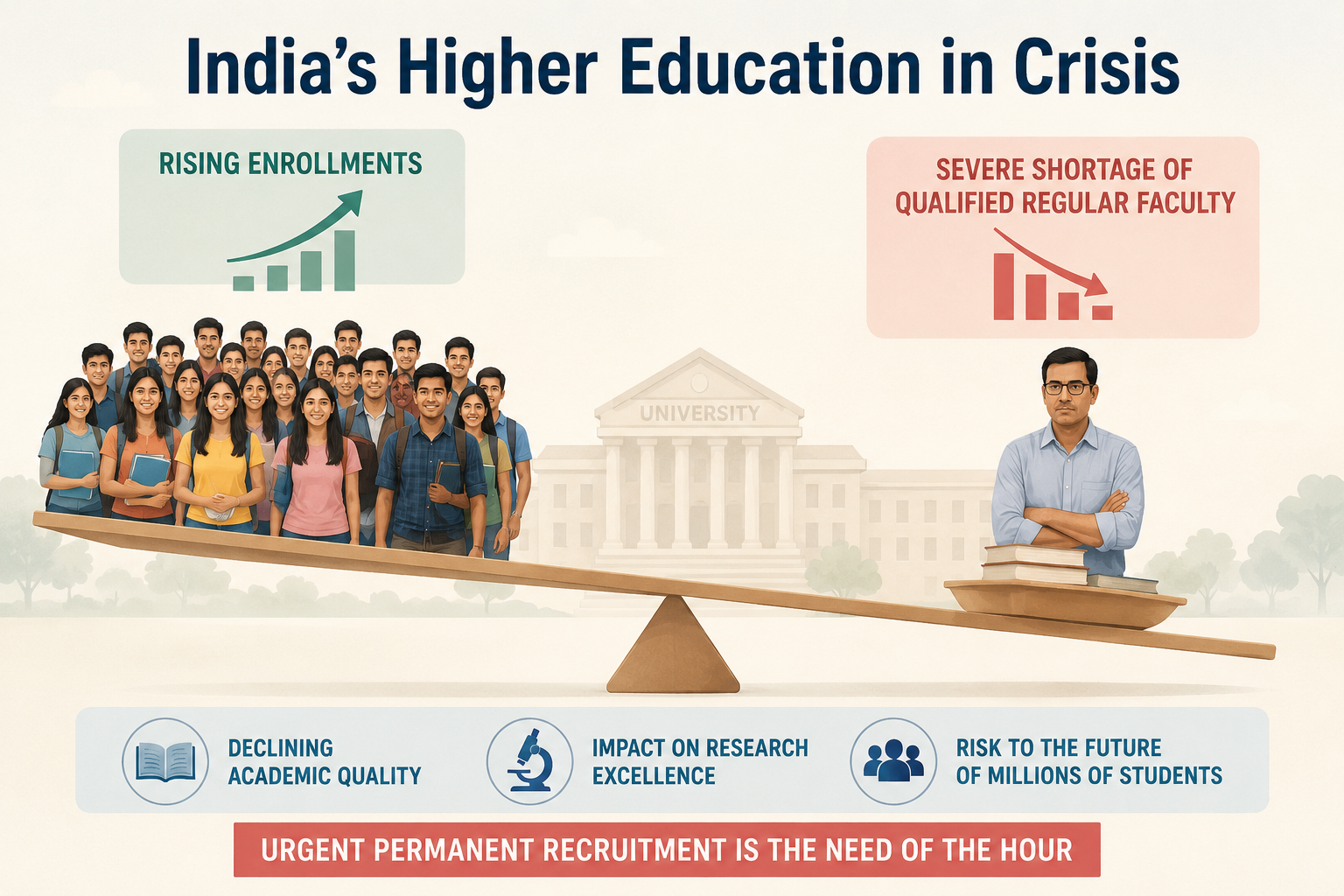
The lack of regular, qualified faculty is a critical challenge in higher education, particularly in India, where it has persisted for decades. As of 2025–2026, many central and state universities face acute shortages, with vacancy rates in some cases exceeding 60%. This phenomenon severely impacts educational quality, research output, and institutional stability.
India proudly presents itself as one of the world’s fastest-growing knowledge economies. Every year, new colleges are established, universities expand their campuses, and thousands of students enroll in higher education with dreams of building successful careers. On paper, this growth appears impressive. But behind this visible expansion lies a dangerous and uncomfortable truth: India’s higher education system is slowly weakening because of the severe shortage of regular qualified faculty.
This is not a small administrative issue. It is a structural crisis that directly affects the quality of teaching, research, innovation, and the future of millions of students. While policymakers often focus on infrastructure, rankings, and digital transformation, the real backbone of education—the teacher—is being ignored.
Across India, thousands of sanctioned teaching posts remain vacant for years. Many colleges and universities operate with a large dependence on temporary, contractual, guest, or ad-hoc faculty. These teachers often work under unstable conditions, receive lower salaries, and face uncertainty about their future. While many of them are highly dedicated and talented, the lack of regular appointments creates a fragile academic environment.
Higher education cannot function effectively when teachers themselves are uncertain about their professional future. Academic excellence requires continuity, commitment, and long-term institutional vision. Contractual arrangements may temporarily fill vacancies, but they cannot replace the stability and responsibility that come with regular faculty positions.
Qualified regular faculty are not simply classroom instructors. They are mentors, researchers, innovators, academic planners, and institutional builders. They shape curricula, guide research scholars, design new academic programs, participate in policy development, and contribute to building a culture of intellectual inquiry. Their presence gives an institution academic identity and credibility. When institutions fail to recruit and retain such faculty, the consequences are severe. Students suffer from inconsistent teaching quality and limited mentorship. Research output declines because temporary faculty often lack the institutional support, time, and resources needed for meaningful scholarly work. Departments lose continuity, academic planning becomes weak, and innovation suffers.
The impact is especially visible in rural and semi-urban colleges, where faculty shortages are often worse. Many institutions struggle to attract and retain qualified teachers due to poor infrastructure, delayed recruitment processes, limited research facilities, and weak career growth opportunities. Students in these institutions are denied the quality education they deserve, creating a serious inequality in access to academic excellence. This crisis has grown because of policy neglect. Over the years, higher education expansion in India has focused heavily on physical growth—new campuses, bigger buildings, increased seats, and institutional branding. While infrastructure is important, education is not built with concrete and glass. A beautiful campus without qualified faculty is nothing more than an empty shell.
There is also a dangerous shift toward cost-cutting in faculty recruitment. Many institutions prefer contractual appointments because they are cheaper and more flexible. This approach may save money in the short term, but it damages educational quality in the long run. Education should never be treated like a business expense where quality can be sacrificed for lower operational costs.
Another challenge is the slow and often bureaucratic recruitment process. Faculty appointments in many institutions are delayed for years due to administrative inefficiency, legal disputes, and policy confusion. By the time recruitment is completed, institutions have already suffered significant academic loss.
The shortage of regular qualified faculty also affects India’s global academic standing. World-class universities are built on strong teaching and research communities. Countries that lead in innovation invest heavily in attracting, developing, and retaining academic talent. India cannot hope to become a global education leader while neglecting the people who create knowledge. If this trend continues, higher education institutions will become degree-distribution centers rather than centers of learning and innovation. Students may graduate with certificates, but without the skills, confidence, and intellectual depth required to succeed in a competitive world.
The solution is clear. India must treat faculty recruitment as a national priority. Vacant posts must be filled urgently through transparent and timely recruitment processes. Institutions must offer fair salaries, professional growth opportunities, research support, and academic freedom to attract talented educators. Rural and underserved institutions need special incentives to build strong faculty teams. Most importantly, policymakers must recognize a simple truth: no education system can rise above the quality of its teachers. India’s future depends not only on how many colleges it builds, but on how many qualified minds it places inside those classrooms. Without regular qualified faculty, higher education will continue to decline silently. And if teachers are neglected today, the nation will pay the price tomorrow.