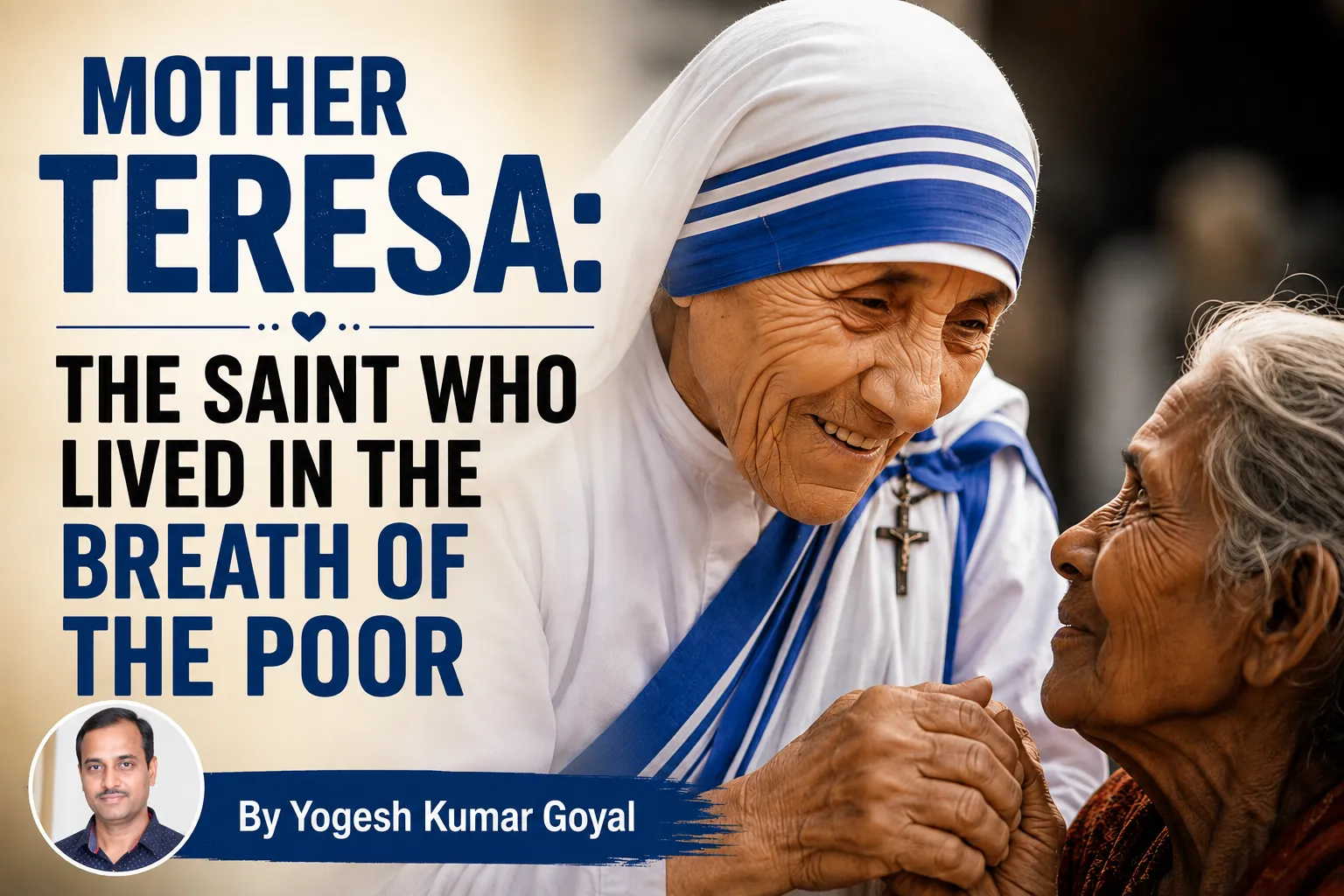
Mother Teresa: The Saint Who Lived in the Breath of the Poor
By Yogesh Kumar Goyal
The very mention of Mother Teresa brings before our eyes the sacred embodiment of humanity, compassion and service. Her life is the greatest testimony to the fact that the resolve to alleviate the suffering of others through selfless service is what makes a person truly great. Born on August 26, 1910, in Skopje, Albania, as Agnes Gonxha Bojaxhiu, this little girl displayed a deep faith in religion and service from childhood. When she was only 12 years old, a resolve awakened within her that her life would be dedicated solely to the welfare of others. This resolve eventually transformed her into an embodiment of compassion for all humanity.
At the age of 18, she joined the Sisters of Loreto and took her first steps towards a religious life. She came to India in 1929 and began working as a teacher at St. Mary’s School in Calcutta. During her teaching years, she taught her students not only academics but also discipline and moral values. However, gradually, her heart was drawn increasingly towards the poor, the diseased and the destitute living outside the four walls of the school. During a journey to Darjeeling in 1946, she found the true purpose of her life. She realised that she needed to rise above teaching and directly serve the poor and helpless. This moment proved to be a turning point that changed the course of her life.
Seeing the unbearable suffering of people living in the slums and streets of Calcutta, she established the Missionaries of Charity in 1950. The principal objective of this organisation was to provide selfless service to the poorest, most helpless and most neglected people. The very motto of the organisation was to serve “the poorest of the poor.” Mother Teresa did not limit the definition of service merely to providing food and medicines. For her, service meant making a suffering person feel that he or she was not alone, and that they were loved and treated with dignity. That is why she would always say, “We cannot do great things but we can do small things with great love.”
Her homes provided not only food and medical care but also restored dignity and self-respect to suffering individuals. She established homes to give leprosy patients a place of respect in society, opened homes for orphans and abandoned children, and made people lying on their deathbeds feel love and affection even during their final moments. Her organisation gradually spread not only across India but throughout the world, with hundreds of centres engaged in humanitarian service in various countries. In recognition of her extraordinary services, Mother Teresa received numerous national and international awards. In 1962, the Government of India honoured her with the Padma Shri, and in 1980 she was awarded the Bharat Ratna, the country’s highest civilian honour. At the global level, she was awarded the Nobel Peace Prize in 1979. In addition, she received the highest honours of several countries. Yet, amidst all these awards and honours, she always remained humble and regarded herself merely as an instrument of God.
Despite the remarkable stature of her life and work, she was not untouched by criticism. On several occasions, she was accused of religious conversion, while questions were also raised about the lack of modern medical facilities at some of her homes. Nevertheless, it is an undeniable fact that Mother Teresa gave hope, support and a sense of dignity to millions of helpless people. The wide-ranging impact of her work can be understood from the fact that she reached the most marginalised sections of society, which were often overlooked even by governments and institutions. When she passed away on September 5, 1997, at the age of 87, the entire world mourned her loss. Leaders from several countries attended her funeral, and India bid her farewell with a state funeral. Even after her death, her organisation, the Missionaries of Charity, continues to serve humanity with the same dedication. In 2016, Pope Francis canonised her, conferring upon her the title of Saint and making her life a global symbol of spiritual inspiration.
The life of Mother Teresa underlines the fact that true greatness lies not in position, wealth or power but in selfless service and compassion. She proved that until we consider the suffering of others as our own, the true meaning of life remains incomplete. At a time when the world is engulfed in violence, inequality and selfishness, Mother Teresa’s message has become more relevant than ever. She taught that love and compassion are the forces capable of bringing humanity together. By rising above the boundaries of religion, caste and language, she demonstrated that humanity is the greatest religion. This is her greatest legacy, and carrying it forward is the duty of every individual.
The occasion of Mother Teresa’s birth anniversary is not merely an opportunity to remember her but also a moment for introspection, compelling us to reflect on how much time and sensitivity we devote in our lives to those in need. If every individual makes even a small effort for the needy people around them, the inequality and suffering prevalent in society can be reduced to a considerable extent. The life of Mother Teresa teaches us precisely this: true religion is service to humanity, and true worship is compassion.
(The author is a senior journalist actively engaged in journalism for 36 years and author of several books including 'Sagar Se Antariksh Tak: Bharat Ki Raksha Kranti'.