
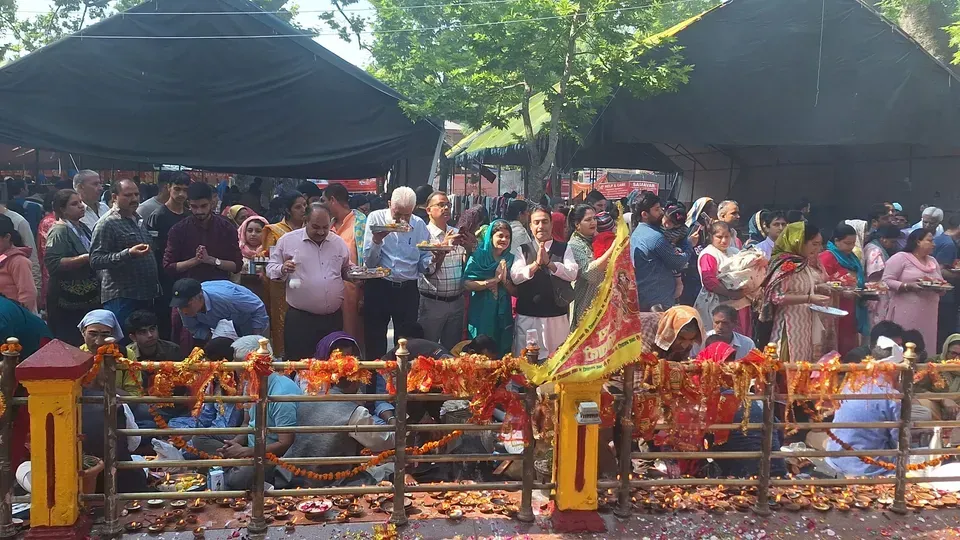
Even decades later, the forced mass exodus of Kashmiri Pandits continues to be a festering wound on Kashmir’s collective conscience. It awaits complete healing as scars of injuries inflicted upon them are still visible.
Kashmiri Pandits have not forgotten how they were chased out of the Valley by Pakistan sponsored terrorists and their bosses sitting across the Line of Control (LoC). They had to leave everything behind and flee to save their lives and honour in 1990.
After their mass migration from their homeland whosoever came into power in the Centre assured them that their dignified return to Kashmir will be facilitated. They were promised jobs, separate colonies and special incentives. Unfortunately, not many promises were fulfilled and Kashmiri Pandits had to remain content with lip service and hollow assurances for more than two and a half decades. However, in 2014 when Narendra Modi took over the reins of the country the regime led by him put in extensive efforts to create conducive atmosphere for return of Kashmiri Pandits to the Valley.
Results of the hard work done by the Centre during the past 12 years are clearly visible. During theseyears separate and secure colonies have been built for Kashmiri Pandits, the temples that had fallen silent stand revived. They have been provided government jobs and every possible security. All steps have been taken to make them major stakeholders in peace and the development of “Naya Jammu and Kashmir.”
Prime Minister Modi led regime has driven home a point that story of Kashmir is incomplete without the Kashmiri Pandit community. For centuries, Pandits contributed immensely to the Valley’s intellectual, cultural, educational and administrative life.
All the doors have been opened for their dignified return to their homeland. Today’s Kashmir is not the Kashmir of 1990 or even the Kashmir of the turbulent decades that followed. The region is witnessing unprecedented infrastructure development, improved connectivity, growing tourism, increasing private investment and expanding opportunities in education, healthcare and entrepreneurship. It is time to ask an important question: if people from outside Kashmir are willing to come and work in the Valley, what is stopping Kashmiri Pandits from returning as stakeholders in their own land?
Across Kashmir, one can see examples of outside reputed healthcare institutions, hotel chains, restaurant businesses and private enterprises are exploring the region’s economic potential.
Entrepreneurs who have no ancestral connection with Kashmir are willing to invest because they see a future here.
If outsiders can display such confidence in Kashmir’s future, the Kashmiri Pandit community, which has an emotional, cultural and historical connection with this land, should also consider becoming active participants in this transformation. The return of Kashmiri Pandits should not be viewed solely through the lens of rehabilitation or government assistance. While security, dignity and justice remain important concerns, the larger vision should be about empowerment and participation.They need to return as key stakeholders to ‘Naya Jammu and Kashmir.’
The community has achieved remarkable success across India and around the world. Today, Kashmiri Pandits occupy important positions in business, technology, medicine, academia, finance and public service. Many have built substantial success in metropolitan cities, Europe, the United States and other parts of the world.
This accumulated knowledge and expertise can play a transformative role in Kashmir’s development.
The younger generation of Kashmiri Pandits represents a unique opportunity. Unlike previous generations, many of them have grown up in a globalized world. They possess professional skills, entrepreneurial experience and international exposure. Their relationship with Kashmir can go beyond memories of loss and displacement. It can be based on opportunity, innovation and partnership.
The future of Kashmir requires human resource in sectors such as information technology, healthcare, education, renewable energy, tourism, handicrafts, food processing and startups. These are areas where the Pandit community can make a meaningful contribution. Instead of seeing Kashmir only as a place of nostalgia, it can be viewed as a place of opportunity where they can become leaders and contribute to economic growth.
The vision of a developed India—Viksit Bharat—cannot be realized without the active participation of all communities. Prime Minister Narendra Modi’s emphasis on inclusive development, infrastructure expansion and youth empowerment has opened new possibilities for regions like Jammu and Kashmir. The aspirations of New India require a New Kashmir—one that is confident, prosperous and united.
In this vision, Kashmiri Pandits have a special role to play. Their return should not be limited to symbolic visits, annual pilgrimages or emotional connections. It should include long-term engagement. They should become shareholders in Kashmir’s future, just as they have become successful contributors to economies across India and abroad. At the same time, the responsibility does not rest solely on the Pandit community. Kashmiri Muslims must create an atmosphere of trust, acceptance and inclusiveness. The mistakes and divisions of the past must not define the future. Young Kashmiris, irrespective of religion or background, increasingly seek peace, employment and development. They want a future driven by economic opportunity rather than historical grievances.
The Kashmir of today is witnessing the emergence of a new generation that values education, innovation and progress. This generation understands that diversity is a strength and that the return of Kashmiri Pandits would enrich the Valley socially, culturally and economically. History cannot be rewritten, but the future can certainly be shaped. The return of Kashmiri Pandits as stakeholders would send a powerful message that Kashmir is moving beyond its painful past toward a shared future of prosperity.
A confident and prosperous Kashmir needs the participation of all its sons and daughters. The time has come for Kashmiri Pandits to look at Kashmir not only through the memories of yesterday but through the possibilities of tomorrow. Their experience, resources and vision can become a valuable force in transforming the Valley into a vibrant contributor to the dream of Viksit Bharat.
Sheikh Khalid Jehangir is a policy analyst, former Vice Chairman of JKPCC, and BJP candidate for Srinagar in the 2019 Lok Sabha elections and presently board member of International centre for peace studies ICPS .


